The Deepfake Hiring Crisis: How AI Is Making Fake Candidates Impossible to Spot
The Deepfake Hiring Crisis: How AI Is Making Fake Candidates Impossible to Spot
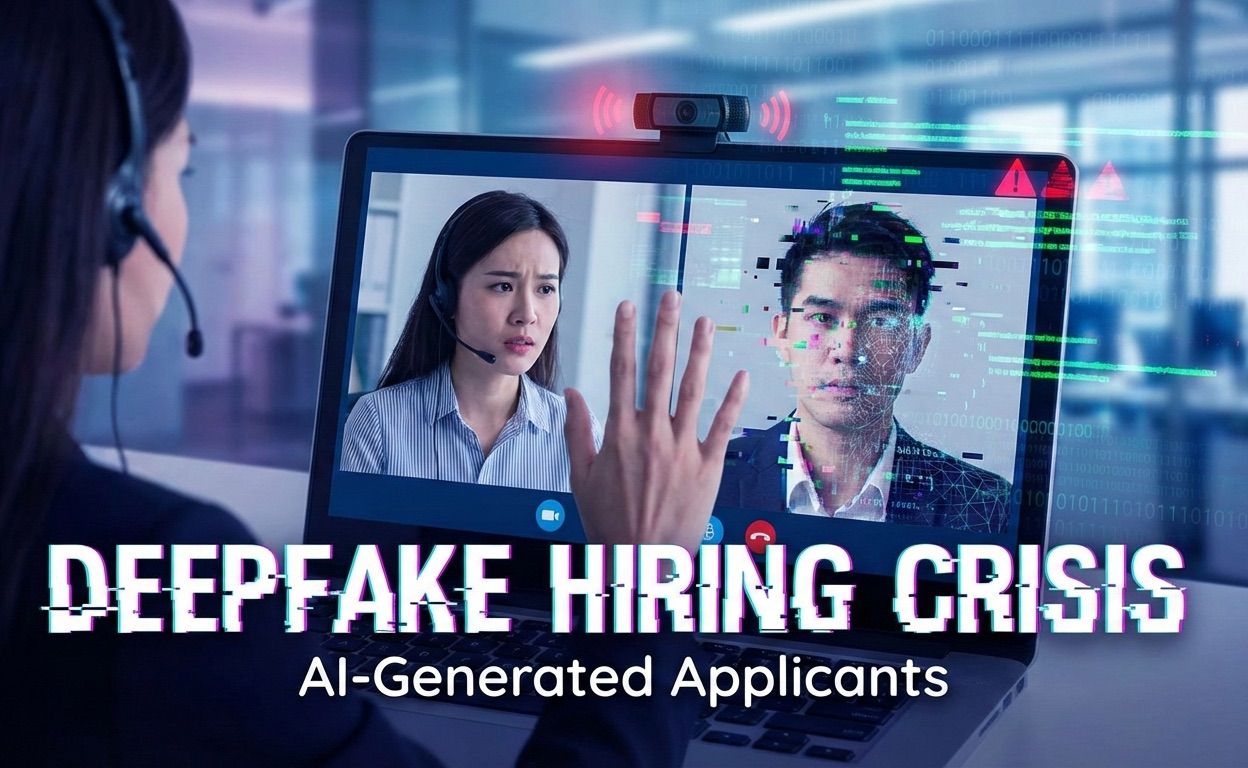
The Deepfake Hiring Crisis: How AI Is Making Fake Candidates Impossible to Spot
It was July 2024 when KnowBe4, a cybersecurity firm, hired what seemed like a qualified software engineer. He aced four video interviews. Background checks came back clean. References vouched for him. Then malware started loading onto his company Mac.
Turns out the "engineer" was a North Korean operative working with a stolen U.S. identity and an AI-doctored photograph. This wasn't some freak incident—it marked the beginning of a crisis that's now spreading across the hiring landscape.
The Scale of the Problem
Around 17% of hiring managers say they've already spotted deepfake candidates during video interviews. That's up from just 3% a year earlier. What's more troubling: 42% of HR professionals suspect they've encountered deepfake fraud at some point, which suggests most cases slip through unnoticed.
Consider what happened when Pindrop Security posted an opening for a senior backend developer. They got 827 applications. When they ran their own fraud detection tools against the applicant pool, roughly 100 candidates—about 12.5%—had submitted fake identities. One of them, dubbed "Ivan X" internally, had facial movements that didn't quite match his words during the video interview.
Gartner thinks this will only accelerate. Their prediction: by 2028, one in four job candidates globally will be entirely fabricated. A Checkr survey of 3,000 U.S. managers found that 35% believed someone other than the listed applicant had actually shown up to their virtual interviews.
How the Technology Works
The tools behind this are far more accessible than most people realize.
Face swapping lets someone overlay another person's face onto their own in real-time—running at up to 30 frames per second, which is smooth enough to fool a live video call.
Voice cloning can generate synthetic speech from just a few seconds of recorded audio. Fraudsters grab voice samples from social media, LinkedIn videos, or conference talks, then feed them into AI systems that produce convincing responses on demand.
Talking head generation takes a single photograph and animates it with natural speech and movement. You don't need video of the target person—just one decent photo.
Tools like DeepFaceLab and FakeApp are freely downloadable. The technical barrier to pulling this off has basically collapsed.
Two Cases That Changed the Conversation
The KnowBe4 Incident
The KnowBe4 breach revealed just how sophisticated these operations have become. The operative used a stolen U.S. identity paired with an AI-enhanced photograph. He passed four rounds of video interviews. Background checks cleared—because the identity itself was real, just stolen from someone else.
When KnowBe4's security team investigated, they discovered the new hire had been planning to ship his company laptop to a "laptop farm"—essentially a warehouse full of hijacked machines. The actual operator, likely working from North Korea or just across the Chinese border, would connect via VPN and work night shifts to maintain the illusion of being present during U.S. business hours.
This wasn't someone trying to collect a paycheck they didn't earn. This was espionage. The salary would flow back to fund weapons programs.
The Pindrop Deepfake
Pindrop's case gave recruiters their clearest technical warning sign yet. During video interviews, the candidate's facial movements were slightly out of sync with his speech—a telltale glitch in real-time deepfake rendering.
When Pindrop's team dug deeper using voice authentication tools, they found another discrepancy: "Ivan" claimed to be calling from western Ukraine, but his IP address traced to somewhere near the Russia-North Korea border.
The North Korea Connection
This has moved well beyond lone actors. A North Korean hacking collective known as "Famous Chollima"—linked to the notorious Lazarus Group—has essentially industrialized deepfake hiring fraud.
The numbers are stark. Confirmed cases jumped 220% between 2024 and 2025. More than 40% of those incidents involved IT workers hired under completely fabricated identities. At least 300 U.S. companies have been infiltrated by fake North Korean employees. Collectively, these operatives have collected around $6.8 million in fraudulent salaries—money that flows back to fund weapons development.
Their playbook is comprehensive: forge synthetic identities, spin up AI-generated resumes and LinkedIn profiles, then navigate technical interviews using real-time deepfake overlays.
Why Standard Hiring Processes Can't Keep Up
Here's the uncomfortable reality: 59% of hiring managers suspect AI fraud is happening, but only 19% feel confident their process would actually catch a deepfake candidate.
The problem is that traditional verification was built for a different era. Video interviews now show fabricated faces rendered in real-time. Resume verification has to contend with AI-generated employment histories. Reference checks can be handled by accomplices or pre-recorded voice snippets played through spoofed phone numbers. Background checks often come back clean because the identity being verified is legitimate—it's just stolen from someone else. LinkedIn profiles look polished and complete, built out with AI-crafted content and believable engagement patterns.
If you're struggling to spot the fakes, you're not being paranoid. The technology really has gotten that good.
Red Flags Worth Watching For
The Hand Test
Ask the candidate to place their hand in front of their face during the video call. Deepfakes struggle badly with occlusion—when an object partially blocks the face. The rendering often starts to break down, glitching like a Snapchat filter losing track of its target. Some candidates will simply refuse.
Other Warning Signs
Watch for lip movements that don't quite match the audio, particularly on sounds like "p," "b," "m," and "w." Notice if there's a consistent delay when you throw in an unexpected question—that can indicate processing lag from the deepfake system or a handler feeding answers.
Be wary of candidates who refuse to turn on their camera or experience "persistent technical difficulties" whenever you ask them to. The same goes for anyone who seems reluctant to turn their head, show their hands, or adjust their camera angle.
Overly polished, generic answers that never get into specifics can be a sign too. So can IP address inconsistencies with their claimed location, or a LinkedIn profile that was created recently and has suspiciously few connections.
The Corporate Response: In-Person Is Back
The deepfake problem has pushed major companies to rethink remote-only hiring.
Google now requires at least one in-person interview for certain roles. McKinsey has quietly added face-to-face meetings before extending offers. Cisco started including in-person stages after noticing that some candidates would suddenly "go quiet" when asked to meet in person—a revealing pattern.
The broader shift is dramatic. In-person interview requests have jumped from 5% to 30% across the industry—a 500% increase. About 72% of recruiting leaders now conduct in-person interviews specifically to guard against fraud. And 81% of Big Tech interviewers say they suspect candidates of using AI tools during interviews.
Interestingly, 70% of candidates say they actually prefer in-person interviews anyway. The shift may be more welcome than HR departments expected.
Building a Layered Defense
No single check will catch everything. The answer is layering multiple verification points throughout the hiring process.
Before the interview, verify government ID with liveness checks—not just a static photo upload. Check LinkedIn profiles for account age and engagement history. Run preliminary reference checks before you've invested interview time. Use proctored skills assessments where you can confirm who's actually taking the test.
During interviews, require cameras on throughout—no exceptions. Run multiple rounds with different interviewers so fraudsters can't refine their approach against a single person. Ask candidates to make dynamic gestures: turn their head, show their hands, move around. Include technical demonstrations that require real-time problem-solving, not rehearsed answers. Throw in unexpected questions to catch processing delays.
After interviews, run digital reference checks that can flag multiple references sharing the same IP address (a common shortcut for fake reference networks). Include an in-person meeting before extending offers, even for remote positions. If possible, use voice authentication to compare speech patterns across interactions.
On the technology side, consider AI-powered fraud detection platforms that offer real-time deepfake alerts, liveness detection, and voice biometric analysis. These tools are improving rapidly and can catch things human interviewers miss.
Where This Is Headed
By 2028, deepfakes will likely be indistinguishable from real video to the naked eye. Hiring is no longer just a talent acquisition function—it's a security perimeter.
Companies that treat it that way—building multi-stage verification, deploying detection technology, training their people to spot the signs—will be far better positioned than those still running 2019-era hiring playbooks.
The organizations that don't adapt will eventually bring on someone who doesn't really exist. And that's not just a bad hire. It's a breach waiting to happen.